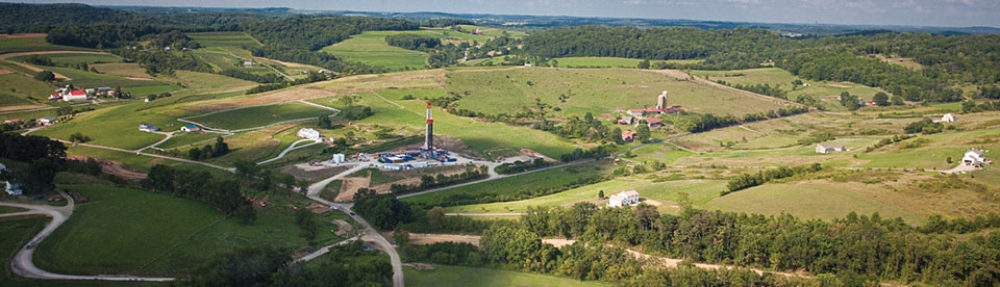
CNX Utica Well Problem

On Saturday, January 26, a well drilled to the Utica formation, about 14,000 feet deep, communicated with several shallow wells, the deepest of which was drilled to about 3,000 feet. This is bad.

The well, drilled by CNX, and called the Shaw 1G, was being fracked. Pressure dropped suddenly and the workers stopped the fracking process. They discovered something blocking the wellbore. There doesn’t appear to be any information about where exactly the blockage is. That could be important because the blockage could indicate a failure in the casing. If there’s a failure in the vertical portion of the casing, that would explain why this well is communicating with much shallower wells. The casing failed and fracking fluid pushed out into the formation or formations that the shallow wells are producing from.

If, instead, there’s a failure in the horizontal portion of the casing, that means that fracking fluid propagated up through 11,000 feet of rock. The Marcellus Shale lies at around 5,000 to 7,000 feet deep in most areas of West Virginia That would mean that the fractures created through the fracking process in a Marcellus Shale well could potentially reach the surface and could certainly find their way into water wells.

The likelihood that the fractures pushed up through 11,000 feet of rock is low. Fracking has been going on for long enough now that it’s hard to believe that under normal circumstances this kind of thing would happen. There just aren’t any reports of it happening. There have been reports of water wells being ruined and of shallow wells being stimulated by fracking, however. Maybe this happens more often than we think, we just don’t realize what’s going on.

Update: The Pittsburgh Post-Gazette is reporting that there are now nine wells impacted by the problem. Interestingly, none of them are in line with the horizontal path of the well. It runs southeast, and the nine wells are to the north, west, and east. Additionally, the other Marcellus Shale wells in the area are not affected. This almost certainly means that the casing in the vertical portion of the well failed and allowed pressure to flow into a formation that all nine of the affected wells are producing from.

Today, You are Like Columbia Natural Gas

Columbia Natural Gas has a little bone to pick with Southwestern Energy. It’s one that you might find yourself picking with the company you sign a lease with, too.

Back in 2007 Columbia signed a sub-lease with Southwestern. That means that Columbia had bought a lease from someone and turned around and sold at least some of the rights to that lease to Southwestern.

In that sub-lease, Columbia made it clear that they expected to be paid a royalty on all of the gas produced, whether it was sold or not. You see, it’s expected that royalties get paid on gas that’s sold. But not all the gas gets sold, and when a company doesn’t sell gas it doesn’t want to pay royalties. In other words, if gas was lost through a break in a pipeline, or flared, or used to run machinery, Southwestern wouldn’t usually pay royalties on it.

In this lease, that was not the allowed. Southwestern had to pay royalties on everything that came out of the ground whether it was sold or not.

Columbia is suing for $17,000 in unpaid royalties, plus any amounts it’s not aware of already. I expect that they think there is a lot more to be paid or they probably wouldn’t be worrying about it.

Your lease probably includes language that says your company doesn’t have to pay you a royalty on gas unless it’s sold. That’s pretty standard. However, if you think that it could impact your royalty checks you should make sure to get a clause in your lease or addendum saying that you’ll be paid on all gas produced, whether it’s sold or not.

Pipeline Explosion in PA

There was another catastrophic pipeline explosion, this one in Beaver County, Pennsylvania.  It happened early this morning, and the company is saying that “earth movement” caused the rupture that lead to the explosion.

The pipeline was 24 inches in diameter, and the resulting fire destroyed one house and melted vinyl siding on other houses within 100-200 yards of the fire.  It also melted a metal tower for a high tension power line, causing it to collapse and pull down other nearby towers.

The most interesting thing about this is that this pipeline was put into service just eight days ago, on September 3, 2018.  It really makes you wonder about the quality control practices of these pipeline companies.  I know the workers wouldn’t purposefully install a pipeline wrong, but people make mistakes and some of these crews just aren’t experienced with building in mountainous terrain.

Pipeline Fire in Kansas

On June 15, 2018 a pipeline in Kansas exploded.  Kansas being flat and mostly fields makes it easier to get good photos of the fire.  Here in West Virginia we can see what is visible above the trees, sometimes only from a ridge or two back from the actual location.  This pipeline exploded in a rural area, so there are no injuries.  We haven’t been able to find any information about the size of the pipeline or how long it’s been in operation.

The State of Oil and Gas: June 16, 2018

An interesting analysis of the current state of oil and gas by Financial Times.  Essentially, lots of people thought that oil prices would stay lower for longer, and the recent jump up over $70/bbl has encouraged a lot of people to think that lower for longer is over.  The article argues that the price of oil will drop again when OPEC starts to open up the spigots again, and explains why they will again in the near future.  It’s that explanation that is worth the read.

Also in the news today, Saudi Arabia has increased oil output by 162,000 barrels per day in May.  That puts them within 28,000 bbl/day of their agreed cap.  With oil prices over $70/bbl, and the oversupply just about gone, it makes sense for them to start producing a little more.

There’s a rumor out there that the Parkersburg cracker plant is back on.  The article was in the Pittsburgh Business Times which requires a subscription.

With new pipelines coming online in the Marcellus/Utica region, one would expect that total production from the region would increase.  It hasn’t.  The Mountain Valley Pipeline and the Atlantic Coast Pipeline might not end up running at anywhere close to full capacity when they are completed because producers are apparently not drilling enough wells to fill what we already have.

I ran across this article from about 2014 that gave a quick overview of most of the big players in the West Virginia Marcellus/Utica area at the time. It’s fascinating to read what people were saying just four years ago and think about what has happened since.

Mountain Valley Pipeline has been issued another violation notice in regards to environmental standards.

This article from Forbes suggests that oil prices will stay up for the next six months.  The arguments is that demand has grown, Saudi Arabia won’t increase production, Iran won’t be allowed to increase production by the U.S., the rest of OPEC can’t increase production and may even decrease production, and the U.S. can’t increase production quite fast enough.  It’s an interesting thought for sure.

This article, also from Forbes, goes into a little more detail as to why U.S. producers can’t increase production fast enough.

Kallanish Energy summarized the Energy Information Administration’s “Short-Term Energy Outlook”.  Energy production from gas will go up about 2% in the next two years, from coal will go down about 2%, from renewables will go up about 1%, and from nuclear will go down 1%.  They’re not big changes, but they fit the overall trend of the last few years.

Another article from Kallanish Energy discusses where the money for a natural gas liquids storage hub in the Marcellus/Utica region will come from, and what it takes to get that money.

Leach Xpress Pipeline Explodes

The Leach Xpress Pipeline is 18 months old.  It’s 36 inches in diameter, runs for 160 miles, and pushes 1.5 BCF of gas at 1440 pounds per square inch of pressure.

It just exploded.

911 Emergency services received 37 calls within three minutes of 4:20 am.  The fire burned until about 6:00 am, or 8:30 am, depending on which news report you find.

The burned area is about 10 acres.

This pipeline is pretty similar to the Atlantic Coast Pipeline and the Mountain Valley Pipeline.  It’s smaller, at 36 inches instead of 42 inches, and shorter at 160 miles instead of 303 miles for the MVP and 600 miles for the ACP.  But they will both push the same amount of gas at the same pressure, and they will both run over more mountainous terrain.

This does not make me feel more comfortable to be living within 1000 feet of the Atlantic Coast Pipeline right of way.

Thankfully, this happened in a spot where there were no houses so no one was injured.

Rogersville Shale Presentation

This presentation was made to the West Virginia Land and Mineral Owners Association by Philip A. Dinterman in 2017.  The slides include a lot of information, but it sure would have been interesting to hear the actual presentation and discussion.  The long and short of it is that the Rogersville Shale is very likely to produce a lot of natural gas when companies get around to drilling into it, but it’s very expensive and hasn’t been well explored as yet so companies are hesitant to throw a lot of resources at it.

Pipeline Tree-sitter being Starved Out

There are two people sitting in trees which are in the right of way that the Mountain Valley Pipeline has bought.  They’ve been there for a few weeks, and people have been bringing them food and water.  The county is no longer allowing people to do that.  It probably won’t be long before they run out of water.

Quite a few Virginia State legislators are protesting the county’s decision to cut off the tree-sitters’ supplies.  It will be interesting to see where this story goes.

The State of Oil and Gas: April 2, 2018

A lot has happened over the last few months, with oil prices rising and gas prices falling.  Some highlights follow.

West Virginia has entered into a Memorandum of Understanding with China Energy, the first step in creating a government/business relationship.  The goal of the relationship will be to develop natural gas downstream facilities in West Virginia.  This is great news for West Virginia.

Oil prices climbed above $60/bbl and pretty much stayed there, thanks to OPEC and Russia extending their policy of keeping production limited.

Cotenancy has passed the West Virginia legislature.  The highlights of the legislation are that if 75% of the owners of a given tract sign a lease, the other 25% can be forced into a lease at the best terms that the other owners signed up at.  There are more details and we’ll get to that in another post another day.

Renewables are not pushing oil, gas, and coal out of the marketplace.  The data and the article are from last year, but the trends are long-term so the article is still worth reading.

Tree-sitters have effectively pushed back the timeline for the Mountain Valley Pipeline to be built.  It will be interesting to see how long this tree-sitting continues.

Atlantic Coast Pipeline: Cutting Trees and Legal Action

The Atlantic Coast Pipeline will begin cutting trees on property where it has already obtained permission from the property owner.  We still have a couple of clients who have not granted them permission, but I live in plain sight of the right of way, so I’ll personally be keeping an eye on how things develop.

One of our holdout clients has received a final offer letter from the ACP, warning that the next step will be to get their attorneys involved.

Not everyone with property affected by the pipeline will be receiving final offer letters.  The pipeline is being developed in stages, and the offer letters will go out over the course of months as the stages progress.

If you’re one of the people receiving offer letters from the Atlantic Coast Pipeline, it’s not too late to work out a favorable agreement.  Most holdouts at this point are holdouts because they just don’t want the pipeline coming across them.  Unfortunately, there’s nothing that can be done about that now, thanks to the Supreme Court’s interpretation of the eminent domain clause of the U.S. Constitution.  The best you can hope for is getting more money, better terms, and better tax treatment.  If you still want some advice about negotiating these things, give us a call.